
The SS United States: A Bittersweet Story of Engineering Brilliance, Bygone Glamour, and Maritime Devotion


The SS United States
When you work on a documentary about the SS United States—the most famous ship you’ve never heard of—you quickly learn two things:
1) Everyone who cares about her cares deeply. (Yes, for the national cult of SSUS fans, ships are female.)
2) You will never again look at a piece of curved chrome or a tapered red stripe without thinking of William Francis Gibbs—the ship’s visionary designer, whose obsession with speed, safety, and innovation turned an ocean liner into a national achievement.
A recent day of interviews brought both truths into focus.
“Permission to come aboard?”


We spent the morning filming with SSUS founding board member and treasurer Mark Perry in his home, a meticulously curated tribute to the ship. Walking through Mark’s front door felt less like entering a house and more like stepping aboard a super yacht: curving walls, sweeping lines, grand views of the horizon, and furnishings salvaged directly from the SSUS. Every corner holds a piece of ocean liner history—models, artwork, stainless-steel fittings, deck chairs, china, framed memorabilia. One guest room is furnished entirely from an original stateroom.
Mark is a ship geek. He wears the badge proudly.
He loves that SSUS wasn’t named for a queen or duchess—but for a nation.

A Symbol of American Ingenuity
The SS United States, built in 1951, represents a moment when Americans—across politics and industries, built something extraordinary together. Materials came from all 48 states. She was the speed queen of the Atlantic, and still holds the Blue Riband for the fastest crossing—3 days, 10 hours, 40 minutes.

She carried presidents—Truman, Kennedy, and Clinton—and a who’s who of classic Hollywood: Charlton Heston, John Wayne, Elizabeth Taylor & Richard Burton, Judy Garland, Debbie Reynolds. She carried immigrants seeing America for the first time.
A Ship That Moves Romantics and Engineers Alike
The SSUS arrived fashionably late to the transatlantic party, christened just as commercial jets were taking over. But her debut still stunned the world.
She was an engineering marvel disguised as a luxury liner: dual engines, a double hull, almost entirely fireproof interiors, and futuristic funnels big enough to swallow a house. She could carry 3,000 passengers in peacetime or move 14,000 troops in wartime (but was never called up.)
And of course, her famous speed.
She could outrun anything.
How fast did she go?
According to maritime lecturer David Eugene Perry (no relation to Mark), the SS United States clocked 38 knots officially, but the real number may be lost to history. Built during the Cold War, her true hull design was classified as a matter of national security. Even the models sold in the gift shop had their underwater lines altered. Because she could be converted into a warship almost instantly, her top speed—the speed that would get her to conflict in record time—was kept secret.

Ship geeks unanimously suspect her speed was higher than 38 knots, and some rumors say 50.
At 900 feet long (not the 1000- foot liner initially dreamed of by Gibbs), she was designed to fit through the Panama Canal locks for faster repositioning. And she was so powerful she could reportedly travel faster in reverse than many ships could go forward.
Speed wasn’t her only bragging right. She was reliable. Other ocean liners were more notorious. A naval mine sank the Britannic. An iceberg doomed the Titanic on its first outing. In contrast, the SS United States was boringly well-built, safe, and on time. Always. Then and still.
She couldn't outrun economics and, eventually, age.
Why Didn’t Restoration Happen?

Mark Perry walked us through decades of attempts to restore the SSUS to service. Over the years, serious players came forward—some with bold designs, some with real momentum, some excitingly close to committing. But at the last minute, something always shifted. Priorities changed. Politics changed. The sheer scale of the project cowed investors. Deals evaporated.
Through the roller coaster ride, the Conservancy kept faith, paying rent at Pier 82 in Philadelphia ($60k/month!)—one of few berths deep and wide enough for a 900-foot vessel.
Then the landlord doubled the rent.
After fifty-five years of slumber, the final countdown began.
A Ship That Outlives Us
This documentary, directed by Bob Radler, with executive producer Mark Perry and producer Kris Mathur, captures the ship at a pivotal moment. Rather than returning to service, the SS United States is slated to become the world’s largest artificial reef—just off the Florida coast.
A dignified and fitting burial at sea.
Some say a Viking’s funeral.

Reefing preserves her legacy in a new form: divers will one day descend through blue water to meet her again, transformed but unmistakable.
As Mark put it, “It’s bittersweet. Not what we hoped for—but the best outcome left.”
Why Reefing? Why Florida?
Okaloosa County, Florida, stepped forward with a practical vision. The region thrives on diving and fishing tourism, and reefing is a proven economic engine. Scrapping a ship erases history. Reefing preserves it through a new way of service.
Marine engineer Steve Perry (no relation to Mark or David) knows the SSUS down to her last bolt. He’s boarded her more times than he can count and calls her “the greatest American maritime achievement of the 20th century.”
Steve opposes reefing. He believes the ship can still be saved, repurposed, kept afloat. He argues that other ships would be safer as dive reefs, and that asbestos from the SSUS, though removed, could still harm the environment. He’s lobbying Congress, refusing to give up. Considering the exorbitant cost of recovering and restoring parts of the USS Monitor (an American Civil War era iron-clad battleship on the sea floor), he argues, why sink the SSUS at all? To Steve Perry, the SS United States is not a lost cause. Not yet. Not ever. Everybody hopes he’s right.
Time is Running Out
In spring 2025, the SSUS was escorted by tugboats from Philadelphia to the Gulf.
The glory of seeing her leave the dock and move one last time down the Delaware River inspired a surge of public emotion, pride and melancholy.

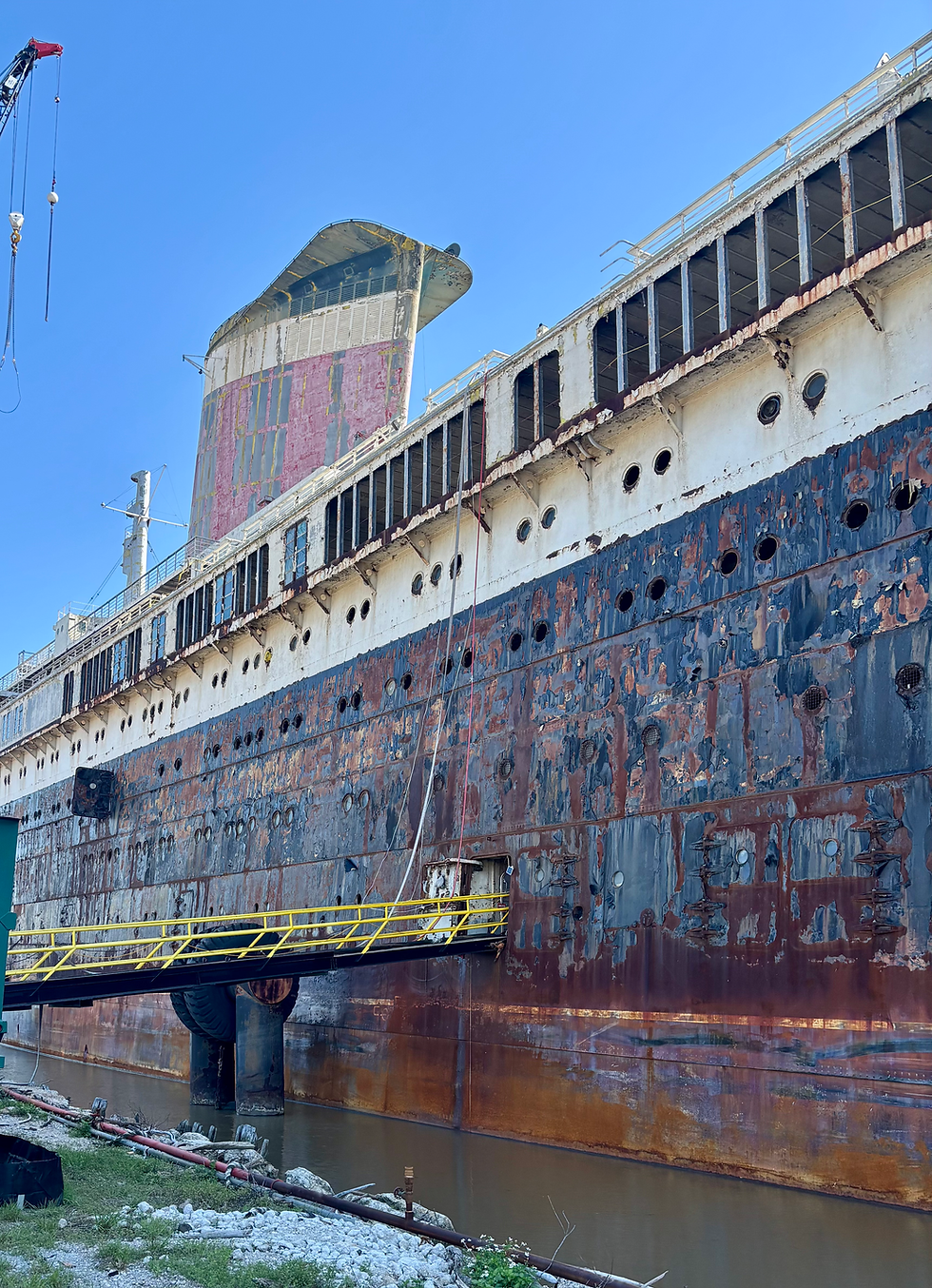
Presently, she’s docked with a professional ship-sinker in Mobile, Alabama where her funnels have been removed and preserved for a commemorative museum. She is being detoxified in preparation for deployment as an artificial reef.
Telling the Story
The coming documentary aims to tell all of it:
The triumph.The heartbreak.The obsession.The ingenuity.The near misses.The what-ifs.
The legacy that will outlive even the reef.
Sign up for my email list at dianamathur.com for updates.
See related post: And Introducing Dexter Gaines, a novel of old Hollywood.
Because loving a ship this much isn’t crazy at all.
#SSUnitedStates #LastOceanLiner #MaritimeEngineering #ShipPreservation #SSUSDocumentaryFilm #IndependentDocumentary #ShipGeeks


Comments